Ceramic Coating Stopped Beading? What to Check First
Ceramic coating stopped beading? Check product history, contamination and recent treatments before deciding on maintenance, polishing or recoating.
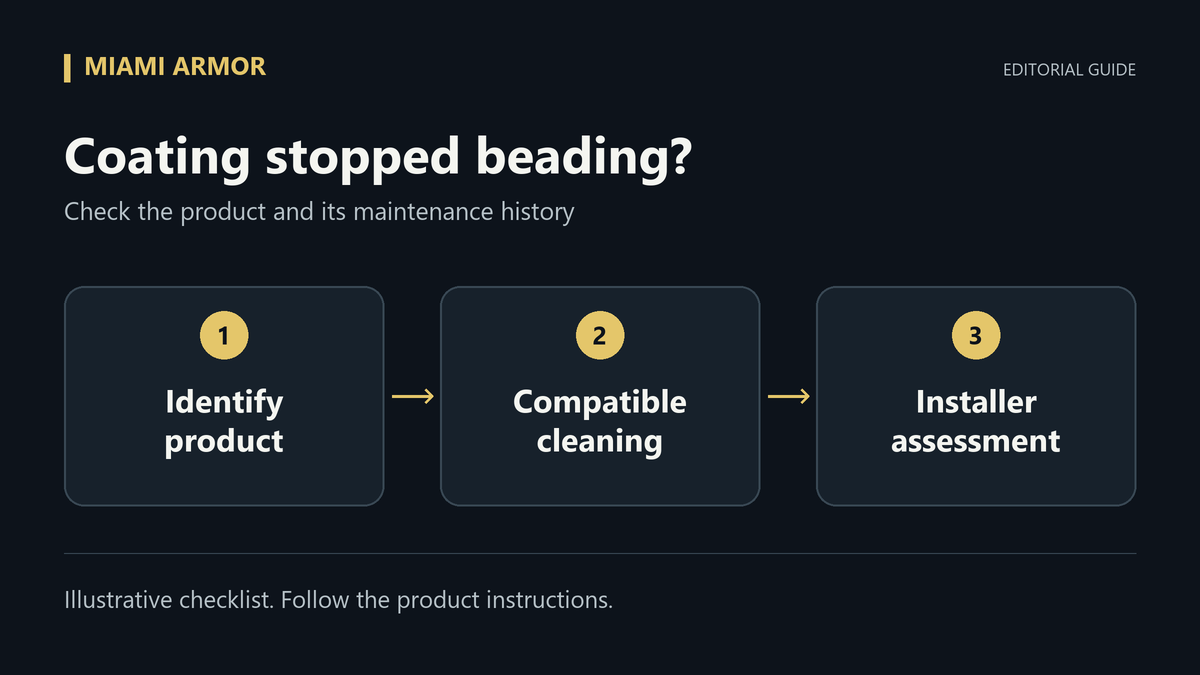
If your ceramic coating stopped beading, do not use that observation alone to declare it failed. Check the installed product, recent wash treatments and contamination before choosing a maintenance process. If water behavior remains changed after compatible cleaning, ask the installer to assess it before polishing or buying a full recoat.
Water collecting differently on a hood is worth investigating. It is not a complete test of every layer on that hood. A fresh spray sealant can also change what you see, so restoring impressive beads does not, by itself, explain the condition of the original coating.
This guide covers an established coating whose water behavior has changed. If the vehicle was just treated, follow the installer's initial care instructions; our separate first-wash aftercare guide covers that handover.
Find out what was actually installed
Start with the invoice or installation record. “Ceramic protection” may refer to different products and application systems. Write down the product name and version, application date, panels treated and any separate topcoat. Note paint protection film, matte areas and panels repainted since installation.
Record any later treatments too: a wash-and-wax shampoo, gloss spray, sealant or maintenance booster. The surface you are observing now may include products added after the original coating. Without that history, a recommendation to add another layer is based on an incomplete picture.
Check the manufacturer's current maintenance instructions and any applicable inspection or warranty process. Product age is useful context, but it is not enough to select a chemical or decide that all protection must be removed.
Check whether the observation is comparable
Compare the same panel before and after the approved cleaning step, using similar conditions where practical. Keep simple photographs or a short video and record the products used. A dirty lower door and a freshly rinsed hood are different starting points.
Avoid adding a booster immediately before documenting the concern. It can change water behavior and make the original question harder to answer. Tell the assessor if one has already been applied; that is useful history, not a reason to hide the result.
Ask what the assessment can establish. Water movement is an observation. It cannot provide a universal measurement of remaining coating thickness, identify every product on the surface or promise protection against a particular contaminant.
Contamination and wear require different responses
Gtechniq's own FAQ explains that road grime can interfere with water repellency, and distinguishes loss of hydrophobic behavior from the condition of the underlying coating system. It also acknowledges that a hydrophobic layer may no longer be present. That is a reason to investigate both possibilities, not a guarantee that cleaning will restore every coating.
Use this decision table to prepare the conversation:
| What has changed | What to investigate | What not to assume |
|---|---|---|
| A gradual change with visible road film | Approved cleaning and product history | The whole coating has reached the end of its life |
| Water behavior changes after a new wash product | What that product leaves on the surface | The original coating alone caused the result |
| A localized change after polishing or body repair | The work completed and protection applied afterward | Every panel still has the original treatment |
| Marks or unusual texture remain after cleaning | Contamination, paint condition and product compatibility | A stronger cleaner or more pressure will solve it |
If the surface has visible damage, lifting film or an unknown special finish, tell the assessor before trying a general coating-maintenance process.
Choose maintenance for the named product
Gtechniq's maintenance guide recommends regular washing, suitable wash media, drying and product-directed maintenance. Its examples belong to its own care system. They should not be converted into a universal dilution or cleaner for a different coating.
Ask the installer or manufacturer which approved process addresses the suspected contamination. Confirm the surfaces it can touch, dilution, working conditions and rinse instructions. Do not mix products, let them dry on a panel or borrow a dwell time from another bottle.
Follow your vehicle's care instructions as well. For example, Tesla's Model Y manual warns about unsuitable cleaners and harsh abrasives. That warning is specific to its care guidance; your own vehicle and installed surfaces need their applicable instructions.
If product identity or compatibility is unknown, request an assessment rather than stacking cleaners until the beads return. An unexplained result should narrow the next question, not automatically increase chemical strength.
Ask for a clear outcome before polishing or recoating
A useful maintenance assessment should distinguish among:
- Clean and reassess. Explain what contamination was identified and what changed after a compatible process.
- Maintain the existing system. Identify any recommended maintenance product and why its instructions fit the installed coating.
- Inspect a persistent defect. Show the remaining concern and whether the issue is with the paint, protection or another surface.
- Plan correction and renewed protection. Define the affected panels, the reason for abrasive work and the protection to follow, if needed.
If polishing is proposed, ask which layer the work targets and what protection will remain afterward. Do not assume abrasive correction leaves the original treatment intact or that the whole vehicle needs the same intervention.
Miami Armor's paint correction service path describes how paint condition and a test area set the scope. A visible defect should be assessed on that basis, rather than using weak beading as permission for another polishing stage.
Questions about lost water beading
Does no beading mean there is no protection left?
Not necessarily. Contamination or later treatments can affect the observed behavior, and different coating systems have different layers. The installed product's history and a suitable assessment are needed.
Can a spray booster prove the original coating is healthy?
No. It can change the surface's water behavior. Record what was applied and ask how the original concern should be assessed before adding another product.
Should I clay a coated car to restore beading?
Do not assume mechanical treatment is appropriate. Check the coating, film and vehicle instructions and ask which compatible cleaning step should come first.
Is a complete recoat always necessary?
No single observation answers that. Ask for findings after suitable cleaning, the reason for any correction and a panel-by-panel scope where relevant. The final recommendation depends on the actual condition.
Use Contact in the site navigation to ask Miami Armor about the next assessment. Have the coating record, affected panels, your South Florida location and a list of recent products ready. Confirm whether the issue and location fit the available service before booking.